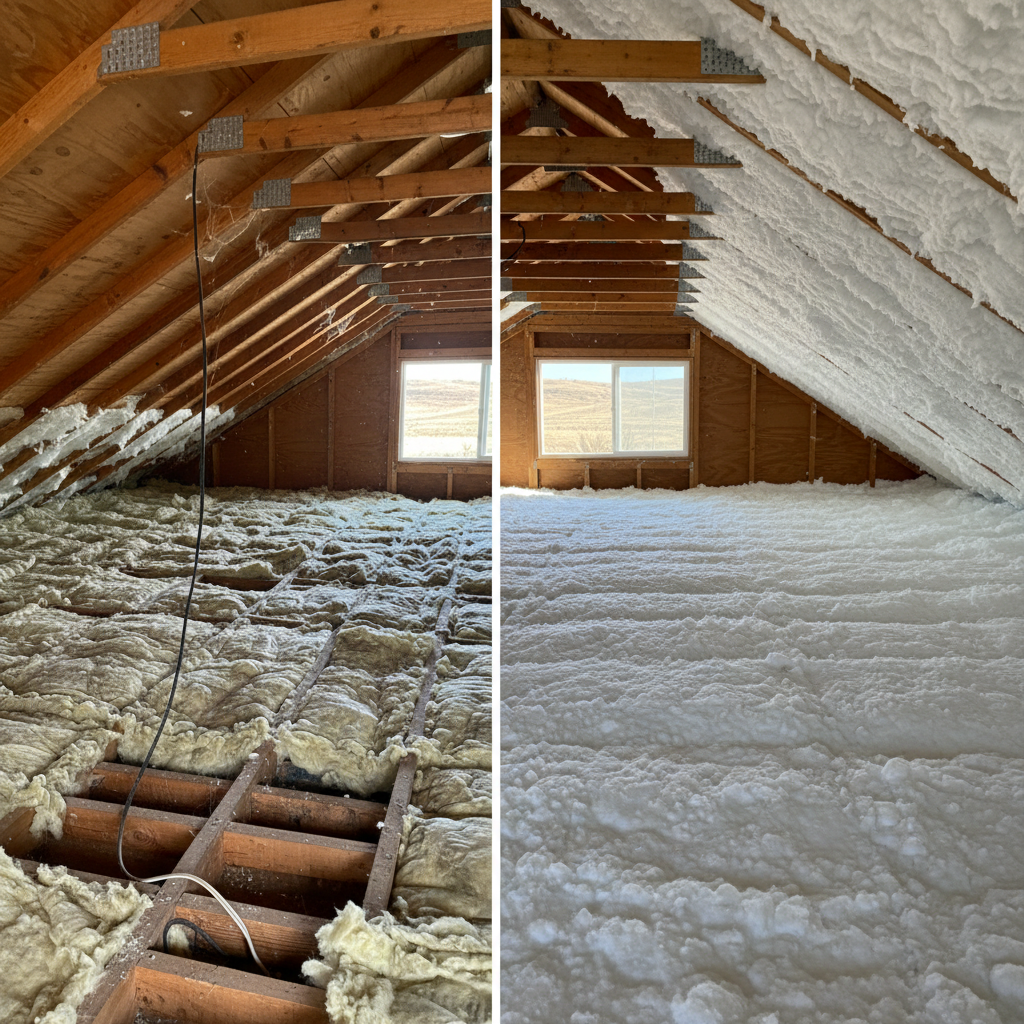
Choosing how to insulate your attic is important for your home. Around Box Elder, our winters can easily drop below zero while summer afternoons bake the roof deck. That puts massive stress on your home's thermal envelope. When homeowners call us at Majestic Insulation Company, they are usually trying to decide between two main options: loose-fill cellulose or traditional fiberglass batts. Majestic Insulation Company wants to break down how they actually compare when you put them to the test against South Dakota weather.
Upfront Costs and Installation Effort
Fiberglass batts are what most people picture when they think of insulation. They come in rolls or pre-cut blankets meant to fit snugly between ceiling joists. If your attic has completely open framing with zero obstructions, laying batts down yourself might seem straightforward. Fiberglass batts tend to have a slightly lower initial price tag if you are buying materials for a DIY weekend project.
Blown-in cellulose requires specialized machinery, meaning you are usually hiring a crew to pump it in. However, the cost difference narrows quickly once you factor in labor and waste. Cellulose is made from recycled paper treated for fire resistance, and it is blown out of a hose as a dense blanket of loose material.
Durability and Air Sealing Performance
The climate in Box Elder tests every building material. Fiberglass batts leave tiny gaps around framing members, electrical wires, and plumbing stacks. In a tight, windy winter, those tiny gaps turn into convective loops where warm indoor air escapes into the attic. That heat loss melts snow on your roof unevenly, creating ice dams that back up under your shingles.
Cellulose behaves differently. Because it is blown in dry or damp at a high density, it settles into every nook, cranny, and hard-to-reach void. It completely surrounds obstacles rather than having to be awkwardly cut around them. Over time, high-quality cellulose maintains its thermal resistance well, though it can settle a bit during its first year. Fiberglass batts can also sag over time, losing effectiveness as they age.
Maintenance and Moisture Management
Attics in our region deal with heavy frost accumulation during deep freezes followed by rapid melting. Fiberglass does not absorb moisture well, which can be a good thing, but it offers zero resistance to air movement unless paired with a separate vapor barrier. Cellulose handles minor moisture spikes a bit more gracefully because the treated fibers can absorb and release small amounts of humidity without losing their structural integrity, though a major roof leak will ruin either material.
If you ever need to access your attic floor to run new wiring or install a ceiling fan, cellulose is messier to move around in. You have to rake it aside and rake it back. Fiberglass batts can simply be lifted up and rolled back down, which makes attic maintenance slightly less tedious.
The Local Recommendation
If you want the honest truth from someone who works on local houses every week, skip the fiberglass batts for your main attic floor. The irregular framing spaces found in many local homes make achieving a true, gap-free seal with batts nearly impossible. Blown-in cellulose gives you a much better thermal blanket, fills the awkward gaps, and keeps heating bills manageable when January winds start howling across the plains. Save the batts for smaller projects like garage walls or shed retrofits where you are working with wide-open, standard stud bays. For homes and businesses in Box Elder, Majestic Insulation Company provides Insulation Contractor services.